About
I am a Ph.D. student at the School of Computer Science and Technology, Tongji University, advised by Prof. Yi Bin, and a member of the Spatial Intelligence Group (SIG) at Tongji University. My research centers on Embodied AI, working toward the broader vision of spatial intelligence: building agents that perceive, reason about, and act within the physical world. During my undergraduate studies, I worked on the robustness of GUI agents.
News
- Sep 2026 Starting my Ph.D. at Tongji University.
- Jun 2026 Received my B.Eng. degree from Tongji University.
- Nov 2025 Our paper D-GARA was accepted to AAAI 2026 as a Poster.
Education
Research Interests
I am broadly interested in Embodied AI: how agents acquire a usable model of the world and turn it into action. I care about building agents that perceive, reason about, and act robustly in real-world environments, and about the reliability that makes them dependable outside idealized lab settings.
Publications
 AAAI 2026
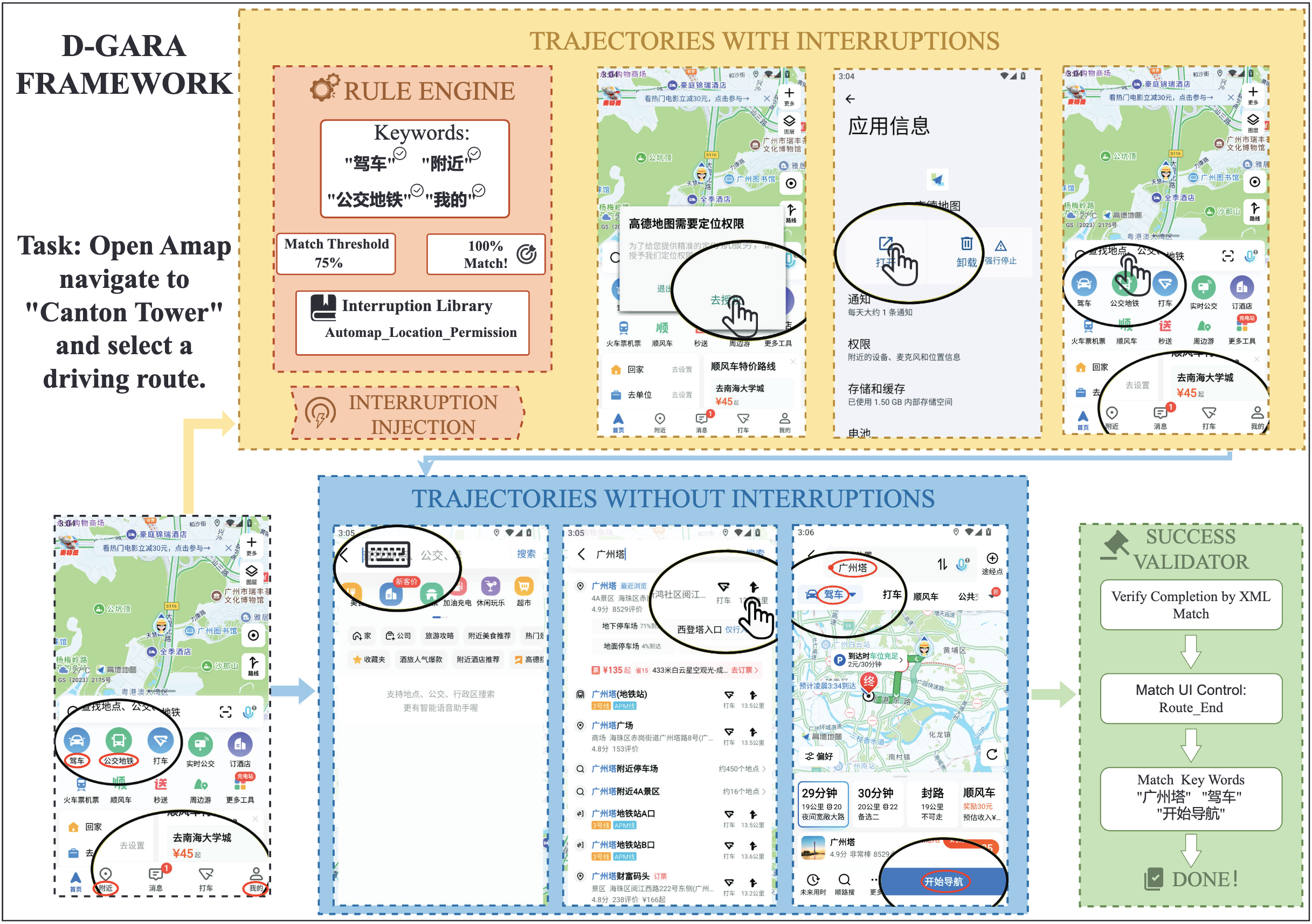
D-GARA: A Dynamic Benchmarking Framework for GUI Agent Robustness in Real-World Anomalies Poster
Sen Chen, Tong Zhao, Yi Bin, Fei Ma, Wenqi Shao, Zheng Wang
AAAI Conference on Artificial Intelligence (AAAI), 2026
A dynamic benchmarking framework that evaluates GUI-agent robustness under real-world Android anomalies.
Research Experience
Exploring research directions in Embodied AI, studying how agents can perceive, reason about, and act within the physical world as I work toward a focused research agenda.
Identified that mainstream GUI agents are limited by anomaly-free training and evaluation. Built a dynamic benchmarking framework to model real-world anomalies and diagnosed three core weaknesses in multimodal reasoning: visual grounding precision, reasoning-chain fragility, and task-endpoint detection.
Awards & Honors
- 18th "Challenge Cup" "Black Technology" Exhibition "Star" Award (FAST Invited Project)
- 2024 China International College Students' Innovation Competition Shanghai Region Gold Award
- 17th National College Students' Innovation Annual Conference "My Favorite Project"